Understanding the historic negotiations shaping water’s future in our region
If you live in the Desert Southwest, this is a pivotal year for the Colorado River. The river supports approximately 40 million people across seven states and Mexico, including more than half of all Californians. This year, those seven states and Mexico must agree on how to share this resource for the next two decades, as the current operating agreement expires at the end of 2026.
This article draws from a January 28, 2026 panel discussion hosted by the California Natural Resources Agency, featuring water leaders from across the Colorado River Basin.
Why Now? The Clock Is Ticking
Negotiators have until February 14, 2026 to reach consensus on a new framework. Without an agreement, the federal government could impose its own solution, or the basin could face costly litigation. The conversation has shifted from “my rights versus yours” to “how do we all adapt together.”
The Challenge: Less Water, More Need
Since 2000, average runoff in the Colorado River Basin has dropped by about 20%, from 15 million acre-feet to around 12.5 million acre-feet annually (The Nature Conservancy (2022): A River in Crisis. Dire conditions in the Colorado River Basin call for collaborative solutions). An acre-foot equals roughly 326,000 gallons—what two average households use in a year.
Climate change is the primary driver. Warmer temperatures increase atmospheric water demand, creating longer dry periods between storms. The basin’s snowpack, which historically provided more than 6 million acre-feet of runoff, is melting earlier each spring. Desert dust blown onto snow accelerates this melting (Colorado State University, (2024): Climate Change in Colorado. Chapter 3 – Changes in Colorado’s Water).
The problem: water allocations remain locked into agreements made during wetter conditions in the early 1900s, creating a growing gap between available supply and allocated rights.
A River Divided: Understanding the Basin
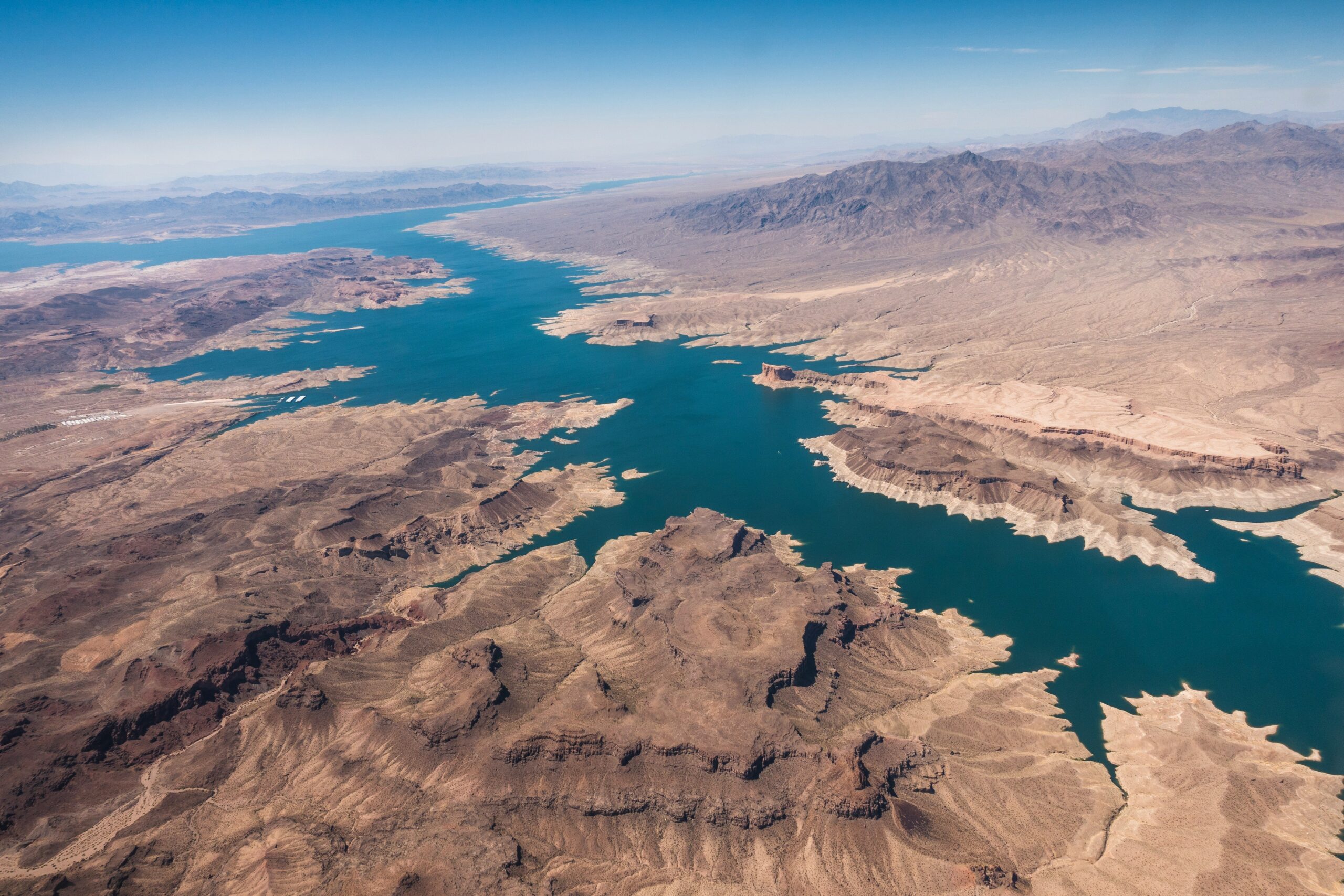
The Colorado River Basin spans 246,000 square miles across seven states. The Upper Basin (Wyoming, Colorado, Utah, New Mexico) is where most snowmelt originates. The Lower Basin (California, Arizona, Nevada) includes desert communities and farmland dependent on water stored in Lake Powell and Lake Mead.
Lake Powell can hold 25 million acre-feet; Lake Mead can hold 29 million acre-feet. For comparison, California’s largest reservoir, Lake Shasta, holds 4.5 million acre-feet. When these massive reservoirs drop too low, hydroelectric power generation suffers and water deliveries become uncertain.
California’s Role: Senior Rights, Shared Sacrifice
California holds 4.4 million acre-feet annually—the oldest and largest water rights on the Colorado River. Imperial Irrigation District produces approximately two-thirds of the nation’s winter vegetables during a 365-day growing season.
California has reduced its Colorado River use to the lowest levels since 1949. In the early 2000s, California permanently reduced use by 800,000 acre-feet . More recently, the state committed to another 10% reduction—440,000 acre-feet annually ((Public Policy Institute of California, 2025).
Solutions in Action: Conservation That Works
Metropolitan Water District serves approximately 19 million people across Southern California (MWD). The district has invested nearly $1 billion in conservation programs and $750 million in local supply projects. Through turf removal rebates, they’ve eliminated 230 million square feet of grass. The region has cut its imported water use in half since 1990 (from 2.5 million to 1 million acre-feet) while adding 4 million residents. Per-capita water use has dropped 40% over 30 years (MWD Colorado River webpage).
Coachella Valley Water District lined 80 miles of canal between the 1980s and 2005, preventing leakage and evaporation. This infrastructure project saves 160,000 acre-feet annually—over 6 million acre-feet to date (CVWD). The district has helped farmers transition to drip irrigation across 70,000 acres, contributing over 100,000 acre-feet to system stabilization since 2022 (CVWD Conservation).
The Fort Yuma Quechan Indian Tribe completed a canal lining project that reduced canal footprint from 50 feet to 27 feet, saving 800 acre-feet. The tribe redirects these savings toward ecosystem restoration to maintain the “living river” their cultural practices require (Quechan Tribe Water Management).
The Federal Government’s Role
The U.S. Bureau of Reclamation manages the reservoir system and acts as “water master” for the Lower Basin (Bureau of Reclamation). This February, Interior Secretary Doug Burgum is convening all seven governors to broker a solution.
The federal government has approximately $1 billion available for infrastructure investments: canal lining, recycling facilities, improved forecasting systems, and soil moisture monitoring.
Mexico: An Essential Partner
A 1944 treaty grants Mexico 1.5 million acre-feet annually (Congressional Research Service). Mexican water managers have consistently participated in basin-wide shortage agreements through the treaty “minutes” process that allows collaborative updates.
Current Status: The Negotiation
California, Arizona, Nevada, and Mexico have offered to reduce water use by 1.5 million acre-feet annually to stabilize Lake Mead. This is significant but insufficient in all hydrologic scenarios—more reductions will be needed.
Key sticking points include:
- How much water gets released from Lake Powell to Lake Mead
- Management of water in reservoirs above Lake Powell
- Ensuring all seven states (not just Lower Basin) contribute to reductions
- Sustainable shortage-sharing mechanisms
What’s Different This Time
California’s Colorado River Board now includes tribal representatives for the first time (Colorado River Board of California). The Imperial Irrigation District covers approximately 470,000 acres of year-round farming, and the Colorado River supports $2 trillion in economic production across the region (California Natural Resources Agency).
The conversation has matured from legal battles to collaborative problem-solving, with proven conservation technologies, willing partners, and federal support.
What This Means for Desert Communities
The Colorado River sustains farms, fills reservoirs, powers cities, and nourishes ecosystems. Imperial Valley’s 365-day growing season depends entirely on Colorado River water. Metropolitan’s service area relies on the river for up to 70% of imported water during California droughts.
The February 14 deadline is real. The building blocks exist: proven conservation technologies, infrastructure investments, and a shared understanding that litigation serves no one. The basin has a chance to write a new chapter where collaboration triumphs over conflict.
Key Sources:
- California Natural Resources Agency, Secretary Speaker Series (01/28/2026): What’s Happening on the Colorado River? Securing Water Sustainability across Seven States
- Public Policy Institute of California – The Colorado River
- Colorado River Board of California
- Bureau of Reclamation – Colorado River Basin
- Metropolitan Water District of Southern California
- Coachella Valley Water District
- 1944 Water Treaty with Mexico